A summary of Part 1 of The Executive Talent Evolution, Luminate's three-part webinar series for executive talent leaders in large, global organisations.
-
If you lead executive talent in a large organisation (or you're building the case to do it more strategically) these frustrations will be familiar.
A reactive approach to senior level recruitment is inherently flawed, and almost everyone around you recognises that too. Why then, given that shared awareness, does it remain so difficult to change?
That was the focus of Part 1 of The Executive Talent Evolution, our three-part series for Heads of Executive Talent, Heads of Talent Acquisition, and CHROs and CPOs in 5,000+ employee global organisations. Joining me was Ville Karkiainen, former CHRO at Kalmar and SVP HR at Cargotec, now CEO of Polar Apex, bringing two decades of first-hand experience building and transforming executive talent functions at scale.
The problem in numbers
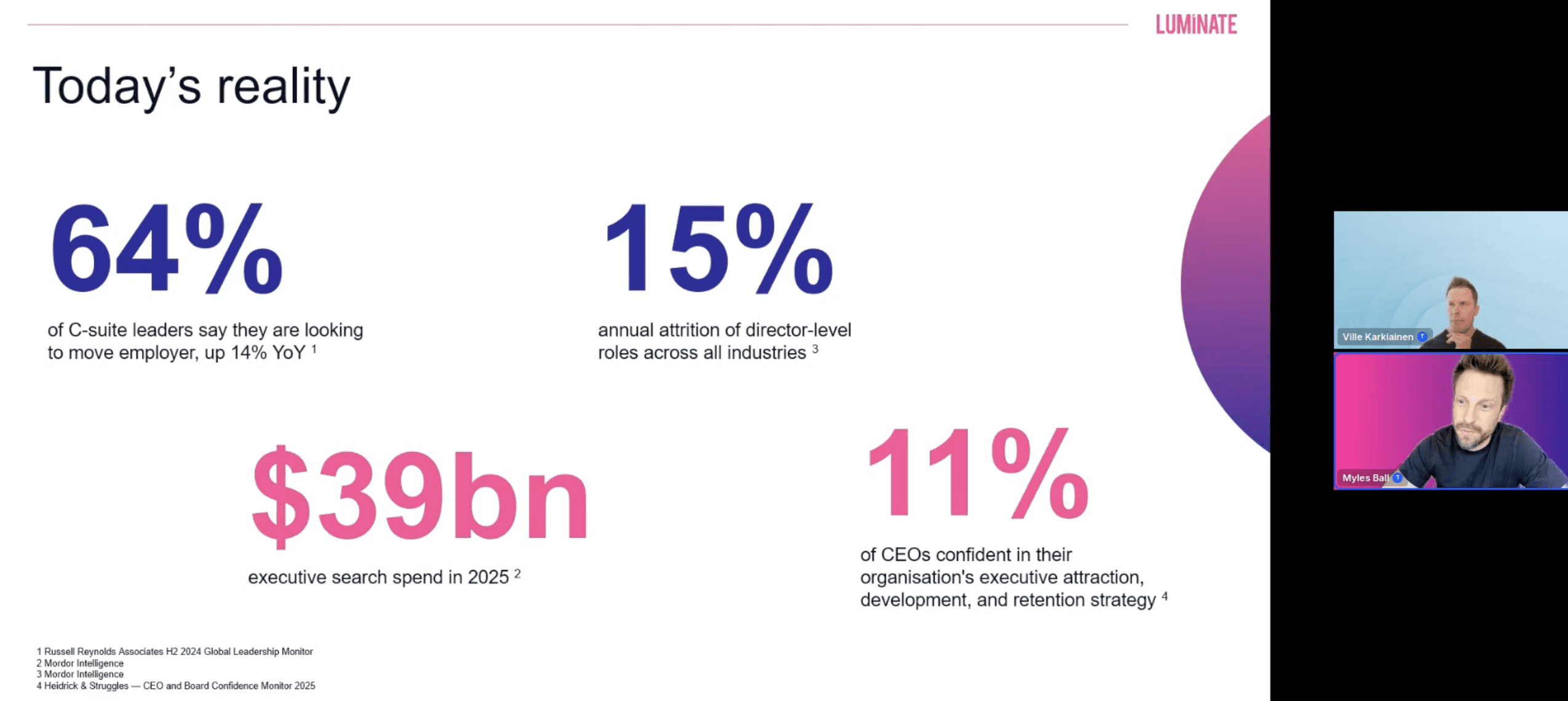
Four data points framed the conversation:
64% of C-suite leaders are looking to move employer, up 14% year on year (Russell Reynolds H2 2024 Global Leadership Monitor). The shift is being driven by economic uncertainty, the emergence of new technologies and skill sets, and a growing willingness to look beyond the current organisation for the next career move.
15% annual attrition at director level across all industries (Mordor Intelligence). For an organisation of 100,000 employees, that is a significant volume of unplanned change to absorb every single year.
$39 billion global executive search spend in 2025 (Mordor Intelligence). A figure that confirms most organisations are still addressing senior talent challenges in the same way they always have.
Only 11% of CEOs have confidence in their organisation's executive attraction, development and retention strategy (Heidrick & Struggles CEO and Board Confidence Monitor 2025). Perhaps the starkest indication that despite the spend, the problem remains largely unsolved.
Over-reliance on executive search
Executive search has become the default response to almost every senior talent challenge. Not because it's the most effective approach, but because it's the most available and most culturally accepted one. The deeper problem is that many organisations have become so reliant on it that they've lost control of how they use it: dozens of unmanaged provider relationships across global markets, no consolidated view of spend, no way to assess which partners deliver and which don't. As Ville put it, for many large organisations the executive search landscape has become a "wild, wild west."
Ville was candid about this, speaking from direct experience of transforming executive talent across a complex global organisation. Getting a grip on spend alone was a significant, almost impossible undertaking:
"The picture will always be incomplete, and one just needs to move on."
When processes are this fragmented, it's impossible to know what's working. Patterns go unrecognised and lessons aren't shared. There's simply no data foundation on which to build anything more strategic.
Starting from scratch, every time
Fragmentation also explains why organisations keep re-entering the market from zero. When a role opens, a search begins fresh. Things are inevitably learned from previous hires, but rarely captured. No structured record of the market, no live relationships with relevant talent, no intelligence that survives the transition from one search to the next.
The real cost of an unplanned senior departure is rarely calculated. It includes the search fee, the disruption of the vacancy, the institutional memory that walks out the door, and the quality cost of a high-stakes decision made under pressure without a pipeline to draw from.
Succession planning: strategic lever or tick-box exercise?
Succession planning is supposed to prevent this. In practice, for most organisations it remains a tick-box exercise: plans built to satisfy governance requirements, reviewed once a year, and disconnected from the hiring activity happening around them. The knowledge that underpins them sits in spreadsheets and slide decks rather than in something that keeps pace with the market. Most talent leaders recognise that succession planning is an under-utilised strategy, and that taking it more seriously is often the most practical starting point for building a more strategic approach to executive talent.
Ville Karkiainen: on driving change in a large organisation
Driving change at this scale inside a large global organisation is a different problem to what it appears on paper. As Ville put it directly:
"Changing the behaviour of yourself is difficult. Trying to do that in concert for thousands of people at the same time, that is hard."
Three ideas from the session are worth carrying forward by anyone navigating this from within a large organisation.
On sponsorship: the agent of change needs a sponsor with real authority, and that sponsor needs to be doing real work, not just lending their name to a slide.
"Never work harder than your sponsor."
On sustaining momentum: the first 90 days aren't the hardest part. The real test comes at one to two years, when those who never believed in the new approach start finding their way back to the old one. Staying the course at that point, Ville said, takes character and a willingness to call out failures openly rather than defend them.
On getting started without ideal conditions: if senior-level buy-in is a challenge, identify an opportunity to pilot a new approach on a small scale – one function, one geography, one defined set of roles – ideally with leaders who are open to new ways of working. Use the experience and the data gathered to build the wider case, demonstrating the value through speed, agility and data ownership, and comparing the return against the ongoing cost of reactive recruitment.
What comes next
Part 1 was about the problem. Parts 2 and 3 are about what to do with it – how to build an executive talent function, and what it looks like when organisations move from reactive hiring towards predictive talent strategies. Follow our LinkedIn for when they get announced.
The recording of Part 1 is available here.